
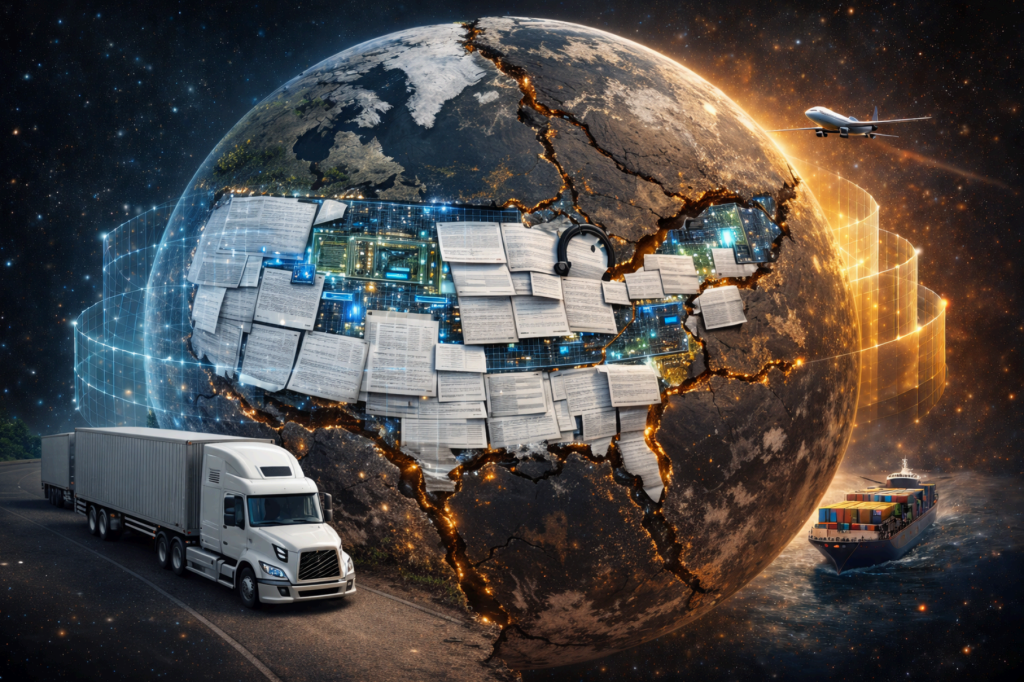
For most of today’s supply-chain history, globalization has depended on an unspoken agreement. Countries will broadly accept common rules of trade.
That hasn’t always been pretty, and it hasn’t always been fast. But it has been frequent enough to allow cargo to keep moving.
But that agreement is showing signs of wear as we approach 2026.
Sanctions, “reshoring,” trade blocs, and economic fragmentation are changing the rules of global cooperation. For transportation, those changes aren’t geopolitical theory. They are new friction costs and delays built directly into international freight movements.
How Weakening Global Cooperation Impacts Transportation
Like most things in the supply chain, transportation hates surprises. From ports to customs authorities to cross-border lanes and corridors, transportation relies on stable standards and consistent enforcement. Alignment lets freight move. Decoupling only causes delays…and costs.
According to the World Trade Organization, even without new tariffs global trade is facing increased friction as multilateral cooperation weakens. More inspections, uneven standards, and regulatory uncertainty create inefficiencies that add hidden cost to supply chains.
Global Fragmentation Changes Trade Flows, Not Volume
Despite rapid fragmentation, experts at the International Monetary Fund project that global trade volume will not “de-globalize” but rather shift toward sub-regional blocs. North America andEurope will continue tightening economic partnerships internally while decoupling from elsewhere. Parts of Asia will do the same.
What does that mean for transportation? Global supply chains will shorten and complexity will increase. Borders and lane bets will face new scrutiny. And freight rates will vary more significantly by region.
Prepare for geopolitics to go from strategy discussion to operational input.
Trading blocs and geopolitical tensions directly impact where goods can ship, which ports and lanes are accessible, and how insurance and risk get priced. Especially in trade-dependent industries, the World Bank warns that even without new barriers political fragmentation disproportionately increases logistics costs.
Standards Are Quietly Going Stakeholder
Standards are the invisible friction in global trade. And they’re going national.
Regionalization and stakeholder politics are driving new standards for data, documentation, and customs transparency. UN bodies, including the UN Conference on Trade and Development, have warned fragmentation threatens to undermine trading efficiency even as customer demand recovers.
When regulations diverge, transportation pays the bill to keep freight moving.
The Next Friction Cost Is Geopolitical Misalignment
Imagine if trade never slows. But agreements on how to move that trade do.
In a fragmented world of 2026, geopolitical misalignment will become a new form of transportation risk. Volatility will still impact transportation budgets. But so will regulatory uncertainty and political disputes that have nothing to do with tariffs.
The Bottom Line
Global cooperation doesn’t need to end to create significant disruption. It just needs to fray.
Geopolitical tensions and stakeholder politics will be baked into transportation rates as countries renegotiate the rules of trade in 2026. Fuel price volatility and demand uncertainty aren’t the only things that could affect your freight budget this year.
Goods will still move across oceans and borders in 2026. They’ll just come with far more “terms and conditions” applied at the lane level.
Ready to future-proof your freight strategy against fragmentation? Our team can help you plan for uncertainty with customized transportation networks that don’t rely on outdated assumptions.
📞 Call: (931) 200-5601
📧 Email: [email protected]