
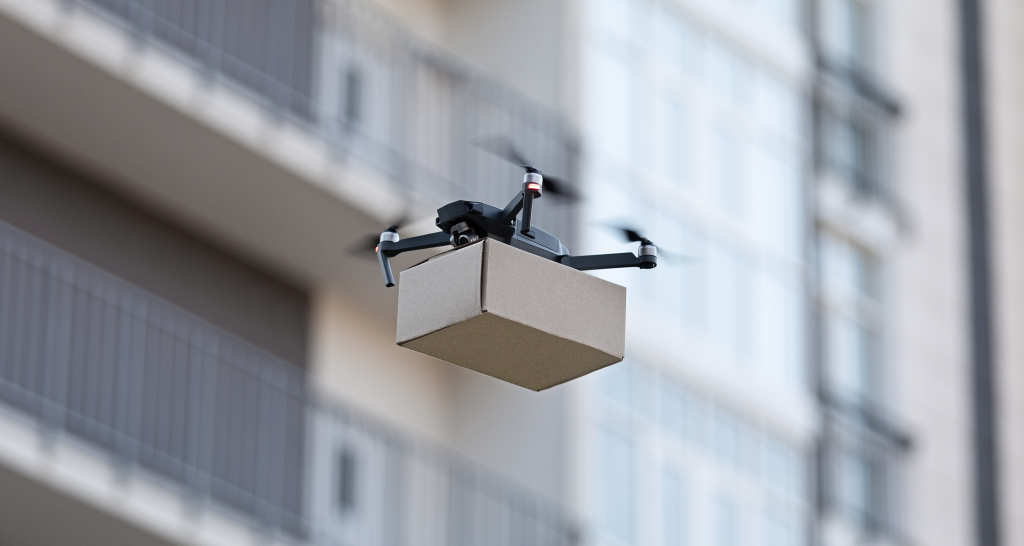
The world of logistics is at the cusp of a new technological turning point, courtesy of drone delivery technology. The idea of parcel delivery by drones has captured people's imagination since Amazon announced its concept of drone delivery way back in 2013. Drone delivery is a tantalizing vision: lightning-fast 30-minute deliveries, reduced carbon emissions, and an answer to expensive last-mile logistics problems. It strives to skirt traffic jams and promises amazingly rapid delivery of less than five-pound items.
The journey from concept to reality has not been without its hurdles. As we look into the current state and future potential of drone delivery logistics, you will understand why this can change some niches, not necessarily replacing the whole delivery landscape.
A Brief History of Drone Delivery
The on-demand drone delivery revolution began in 2013 when Jeff Bezos unveiled his ambitious plan on 60 Minutes. He announced Amazon Prime Air, where a future of self-flying drones would deliver packages to people's homes within 30 minutes of ordering. The idea found quick popularity outside of the Amazon domain, too: Zipline pioneered medical supply deliveries in Rwanda. SkyDrop did successful deliveries of 7-Eleven Slurpees and Dominos pizzas. Google's Project Wing did burrito deliveries to college campuses. And then the big logistics companies like DHL, UPS, and FedEx jumped on board.
These industry behemoths signed on with new drone technology firms to solve their last-mile delivery issues. The press trumpeted every first flight, envisioning a future of skies filled with delivery drones. The promise was irresistible: "Anything, anywhere, anytime" – a world in which traditional delivery methods would be obsolete. Drone delivery promised to be clean, fast, and convenient for packages under five pounds, without getting stuck in traffic jams and reducing fossil fuel consumption.
This revolutionary idea attracted tech inventors, venture capital investors, billionaire entrepreneurs, and global logistics corporations. The race toward airborne deliveries had begun, with heavy investment and fast advancement of technologies that made the concept seem progressively more feasible with each passing day.
Challenges in Drone Delivery Services
The path to full-scale adoption of drone delivery is long and hard, with very stiff regulatory and technological hurdles to surmount. The Federal Aviation Administration imposes stern restrictions on the operations of drones, throwing up elaborate barriers before companies wanting to set up delivery networks.
Take Phoenix as the best example: with its year-round sunny weather and sprawling neighborhoods, it would appear to be a nirvana for drone delivery. But reality shows a different picture: the FAA has restricted much of the airspace around Phoenix Sky Harbor International Airport and Luke Air Force Base, plus scores of smaller airports, lowering considerably the number of square miles that the drones can potentially serve. When such restrictions cast "no-fly zones" over large swaths of metropolitan areas, operational areas of the service start fragmenting in pieces.
Regulatory Challenges
The Federal Aviation Administration has strict regulations that make it very difficult for firms to utilize drones in offering their services. Such regulations pose very intricate challenges for these businesses seeking to set up delivery systems using drones. Those rules become even more difficult in cities like Phoenix, which seem tailor-made for drone deliveries with their sunny weather and sprawling neighborhoods. The FAA has put some areas around airports and military bases off-limits to drone flights, limiting where companies can offer their delivery services.
Technological Challenges
The technological challenges are not limited to the airspace constraints. The drones require very precise computer vision and AI systems for safe landing zone identification, obstacle detection, and accident prevention. The systems should be able to identify windows, pets, pools, and other common obstacles reliably. The last-foot delivery of the packages from hover height to the ground remains a singularly unique challenge.
Solutions Tried by Companies
Companies have tried multiple solutions to these problems. Zipline uses parachute-equipped packages, while Matternet designed single-purpose delivery landings. Wing and others use rope-lowering from safe heights. These methods are most suitable for single-family homes, private yards, clear unobstructed delivery zones, and areas beneath restricted airspaces.
Service Area Impacts
When combined, regulatory restrictions and the technological constraints effectively lower, to a large extent, regions within which drone delivery services can operate viably. For instance, in most metropolitan areas, a standard drone's six-mile radius might well be reduced to less than one-tenth possible users.
Current State and Market Viability of Drone Delivery
The drone delivery market is far from what was envisioned. A consumer survey in 2016 has found that 70% of customers prefer to have the cheapest delivery option while only 23% of them are ready to pay for same-day delivery. This depicts a low demand for expensive drone delivery services.
The Growth of Food Delivery
The food delivery industry has seen incredible growth and is now a $150 billion global industry as of 2017. Companies such as Uber Eats, Grubhub, and DoorDash have dominated the market with established, low-tech solutions that meet consumer demands for fast and reliable service.
Benefits of Traditional Delivery Methods
Traditional methods of delivery still have several benefits over drone delivery. Existing infrastructure requires minimal extra investment, and they offer flexibility in handling different delivery scenarios without specialized landing zones. They also benefit from consumer trust through a history of proven service and broader coverage without airspace and weather restrictions.
Recent Market Developments
The recent market events reflect a rethinking of priorities, with Amazon Prime Air offices being closed in the UK and DHL canceling its Parcelcopter program, along with limited commercial deployment beyond pilots. The gig economy model, flawed as it is, has taken care of the last-mile delivery problem effectively. Food delivery apps have expanded their services beyond restaurants to include groceries, medicine, and general merchandise, directly competing with the market that drone delivery aims to serve.
The Rise of Ground-Based Autonomous Robots
Ground-based autonomous robots are now being viewed as a more feasible alternative for automation. These solutions require less regulatory hurdles and infrastructure compared to aerial delivery systems, resulting in them being an attractive option for companies to reduce their delivery costs while maintaining the quality of service.
Innovative Use Cases for Drone Technology Beyond Retail Deliveries
While retail drone delivery has been beset with issues, healthcare use cases have been hugely successful. Zipline, a Silicon Valley startup, started from running a few dozen flights per day in Rwanda to becoming one of the most critical medical supply chain solutions in numerous areas. The healthcare model works because medical products are needed but used infrequently, and short shelf lives make stocking efficiently challenging.
Most remote clinics can sit hours away from distribution centers. Poor road infrastructure creates access issues. Zipline's drones bridge this gap, delivering critical medical supplies to remote clinics across Rwanda's rolling hills. Success here has brought expansions to Rwanda's Eastern Province, four regions in Ghana, United States, and Ivory Coast (in development).
Other firms, like Matternet and Wingcopter, have taken note of this and focused on the success within medical applications. With this niche in healthcare, drone delivery proved perfect at solving problems otherwise impossible to address with classical means of transportation. That's opening up possibilities for other specialized applications where aerial delivery provides unique advantages in fields such as emergency response supplies in disaster zones, time-sensitive laboratory samples, organ transport between hospitals, agricultural monitoring and supply delivery, and remote infrastructure inspection.
Such focused applications really bring out the potential of drone delivery, not as a panacea but as a strong tool in those specific, high-value scenarios where traditional delivery methods are at their weakest.
The Future of Drone Delivery Logistics: Opportunities and Challenges Ahead
The drone delivery industry is at such a critical juncture where new technology can totally change its course. Recent innovations in AI are likely to solve big navigation challenges that have held back the widespread adoption of drones.
Improved object recognition will let drones identify more precisely a safe place to land or find obstacles, and even navigate complex areas more precisely. Advanced algorithms will enable drones to make decisions in real time to change their routes or course due to weather conditions, airspace restrictions, and surprise obstacles. New technologies must solve the challenge of being able to make deliveries right at the customer's door through autonomous precise landings and innovative new methods of delivering packages.
The strategic partnership between logistics companies and technology providers is about expanding operations. Such partnerships bring logistics expertise, existing distribution networks, technical innovation, expertise in drone technology, knowledge of regulatory compliance, and solutions for operational scalability.
Looking forward, companies will need to focus on building infrastructure through charging stations, maintenance facilities, and control centers. They must develop standards including safety protocols, operating procedures, and quality control measures. Creating ecosystems involves developing partner networks, integrating supply chains, and enhancing customer service systems.
This evolution of the industry shows a movement from more general hopes of bringing packages to every consumer to specific, high-value applications. Now, companies are focusing on specific scenarios where drone delivery clearly has advantages over traditional methods. This way, the companies can focus their efforts on the creation of solutions that exactly meet real market needs.
Understanding Consumer Attitudes and Market Trends
Recent surveys threw up some surprising twists in consumer attitudes toward drone delivery. While 70% of consumers prefer to keep costs down with traditional shipping methods, only 23% would be willing to pay extra for same-day drone delivery services. This is primarily because of concerns over reliability and safety of autonomous systems, potential job displacement in delivery, and cost implications for end-users.
The market keeps on changing, and the leading established players in the last-mile delivery space are Uber Eats, Grubhub, and DoorDash. These companies have been able to handle the consumer's immediate needs quite effectively through traditional methods, creating a large barrier for drone delivery adoption.
Yet, the future is not entirely grounded. Success will be found in identifying concrete niches where drone delivery has unique value, like Zipline's medical supply deliveries to remote areas. For companies navigating this shifting landscape, it means partnering with experienced logistics providers that know the way.
Ready to discover innovative logistics solutions for your business? We at National Freight Connection excel at creating tailored delivery strategies catered to specific needs and market demands. Let's work together to optimize your supply chain for the challenges of tomorrow. Give us a call today at (931) 200-5601!