
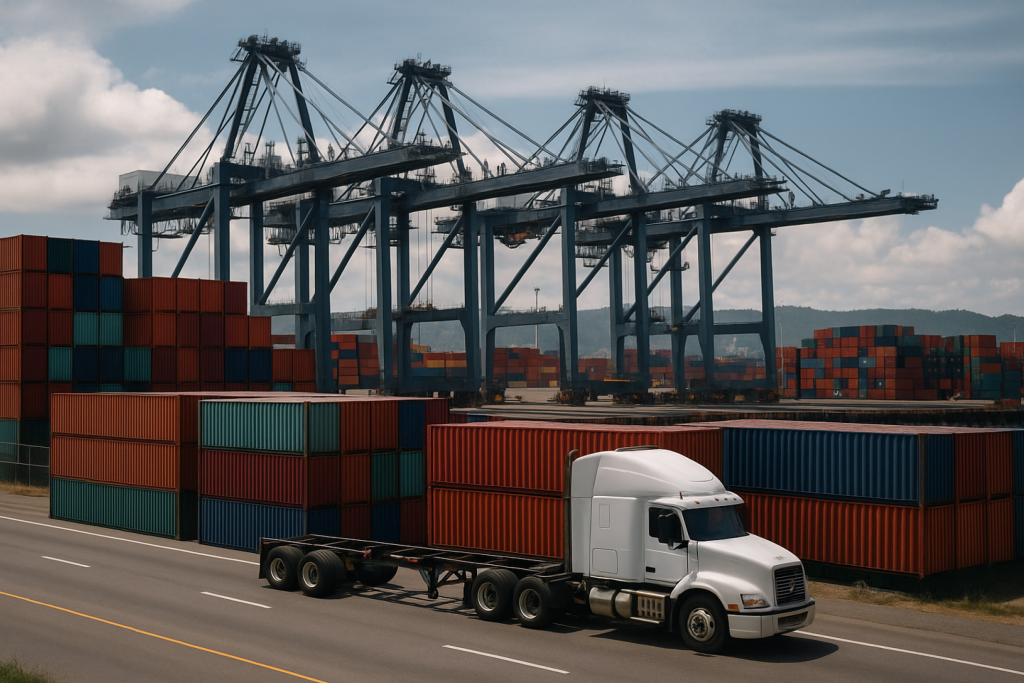
The U.S. freight industry is changing fast, and it starts at the ports.
Trade routes are evolving, tariffs are fluctuating, and congestion at primary gateways is paralyzing supply chains.
The result? Shippers are no longer putting all their containers in one port.
Port diversification, the practice of spreading freight across multiple ports rather than just the usual suspects like LA or Long Beach, is increasing.
It’s smart. It’s necessary. But it’s also shaking up the inland trucking industry
National Freight Connection is already helping clients navigate the new port diversification era, and we’ve got the inside scoop if you’re wondering how your inland freight strategy measures up.
⚠️ First, the why: 3 Reasons for the Surge in Port Diversification
● 📉 30% of U.S. orders from China have been scrapped due to 145% tariff rates● ⛴ Ports like Savannah, Charleston, and Houston are booming as shippers diversify
● 🚧 Infrastructure projects like the $150M Otay Mesa East expansion are opening new cross-border gateways
The shift has pros, but not without challenges: evolving regulations, fraud risks, infrastructure bottlenecks, and increased trucking costs.
Let’s dig into it.
🚚 5 Ways Port Diversification Is Changing Inland Truckload Freight
1.📍 The Rise of Secondary Ports
Congestion at top U.S. ports is getting worse: wait times increased 25% last year (Hapag-Lloyd).
Facing limited capacity, shippers are spreading freight through secondary ports that can move more quickly.
Ports like Savannah, Charleston, and Houston are booming, leading to new inland lanes and trucking routes.
✅ Action Step: Work with carriers and brokers familiar with these lanes and new entry/exit ports and can provide flexible, real-time tracking so you can react on the fly.
2. 🧭 Increase in Regional Hauls, Decrease in Miles
Diversification means decentralization. Inland from the top ports, we’re seeing regional hauls under 500 miles surge, up 40% in the past 12 months (ATA).
Higher-speed routes are feeding into e-commerce growth and faster delivery models.
✅ Action Step: Optimize your truckload efficiency with smarter routing, multi-stop planning, and AI-powered load matching.
3. 📝 Compliance Gets Complicated
California’s recent emissions rule rollback created a crazy quilt effect: some states (e.g. New York) aren’t budging while others are loosening up.
This means carriers on inland routes from new ports must now navigate a maze of emissions laws and equipment standards.
✅ Action Step: Partner with 3PLs and brokers that know how to handle state-by-state compliance so you don’t get snagged.
4. 🕵️ Increased Fraud Exposure
New ports and routes mean new risks. Fraudsters are adapting quickly: cargo theft topped $223 million last year while fake carrier scams increase 25% annually (JOC.com).
✅ Action Step: Verify carriers with FMCSA tools to stop fake carriers and adopt blockchain and AI monitoring tech to better secure your high-value loads (it can cut theft risk by up to 20%).
5. 🛣️ Infrastructure Strain
Pushing freight through smaller ports increases pressure on inland roads, rest areas, and freight terminals.
Capacity challenges have increased on 35% of truck routes as volume soars, according to industry reports.
✅ Action Step: Access load boards like DAT for smarter planning and partner with 3PLs and brokers that have scalable, nationwide networks.
📊 The Big Picture: Trends in Port Diversification Matter
Port diversification is a smart strategy. But it’s far from simple. It could mean higher costs, delays, and more, depending on how you approach it.
Here’s what it means for your business:
● 🚚 Higher Costs: Trucking from new ports often increases your TCO by 10-15%.
● ⏱️ Delays: New routes add an average of 8-12 more hours of transit time.
● 📉 Customer Churn: 45% of customers will look for new carriers after repeated delivery delays.
● 🌱 Sustainability goals at risk: Longer routes mean higher emissions, making it harder to meet sustainability goals.
👀 Eye on Industry Experts
● Carriers: 60% are adapting to new routes but cite fraud and capacity as top concerns.● Shippers: Major retailers like Walmart and Target are using diversification to improve delivery times.
● Analysts: Expect 20% more demand for inland trucking by 2030 due to diversification trends.
🧭 How National Freight Connection Can Help Navigate the Changing Freight Landscape
Port diversification is the new normal. And National Freight Connection helps clients adapt to changing routes without missing a beat.
● ✅AI-Powered Routing: We optimize routes from secondary ports inland to save time and money.
● ✅Blockchain + AI Fraud Prevention: Protect against theft and fraud with our tech-forward security measures.
● ✅Nationwide Carrier Network: Scale up or down at a moment’s notice with a carrier network that’s ready and waiting across the country.
● ✅Compliance Experts: We stay on top of emissions regulations, interstate and cross-border paperwork so your loads stay moving.
It is the same inland ripple playing out right now, where freight piling up at the ports lands on lanes weeks later and hundreds of miles away.
📚Takeaway: Don’t Wait to Adapt
Port diversification isn’t just a trend, it’s a structural shift in the freight industry. If you haven’t adapted your inland freight strategy yet, now’s the time to get started.
Let’s talk about building a logistics plan that’s ready for whatever 2025 has in store.
📞 Call us at (931) 200-5601
📧 Email: [email protected]