
Every major freight market disruption in recent memory has come from inside the supply chain. A pandemic. A port strike. A fuel shock. A regulatory crackdown. Shippers and carriers have built risk models around those categories because those are the levers that have historically moved volumes.This one is coming from a different direction entirely.
GLP-1 medications, semaglutide and tirzepatide drugs sold under names like Ozempic, Wegovy, and Mounjaro, are quietly beginning to reshape how Americans eat. That shift in consumption flows directly into what gets manufactured, what gets shipped, and what lanes carry what volume. The freight implications are not catastrophic. But they are real, they are building, and they are being underestimated by most logistics teams whose visibility stops at the dock door.
How Big Is This Actually Getting
Start with the adoption numbers, because they tell you something about the pace of change. Gallup's National Health and Well-Being Index found 12.4% of Americans taking GLP-1 medications for weight loss as of late 2025, up from 5.8% in early 2024. That is more than a doubling in roughly 18 months, and the climb has not flattened. Prescriptions for non-diabetic patients surged 700% between 2019 and 2023 per BMJ research. Circana's data shows 78% of current GLP-1 users now take the medications specifically for weight loss, up 41 percentage points from 2021, which tells you the original diabetes management use case has been largely eclipsed by appetite suppression.
The commercial scale of this is what matters for freight planning. Circana's November 2025 report found that approximately 23% of U.S. households currently have a member on GLP-1 drugs. By 2030, those households are projected to represent 35% of all food and beverage units sold. That is not a niche consumer cohort. That is the mainstream grocery shopper.
FreightWaves did the freight math and arrived at a number worth sitting with: at roughly 12% adult penetration, GLP-1 adoption is associated with an approximately 3% drop in total caloric food demand. Three percent may sound modest until you remember that U.S. trucks move more than 2 billion tons of food and beverages annually. A 3% structural reduction in that volume is larger than the projected freight impact of a major proposed railroad merger, and GLP-1 penetration is still in what FreightWaves called the early innings.
What Categories Are Losing and What Is Growing
Not all food freight is exposed equally. The categories losing volume are specific, and so are the ones gaining.
The losers cluster in what FreightWaves called classic snack-and-beverage freight lanes. Processed snacks and beverages are seeing user spending down 7 to 11% among GLP-1 adopters. Beer fits squarely in the broader beverage decline, and PwC research adds useful context: the top 10% of alcohol drinkers account for nearly 60% of total U.S. alcohol sales, which means a behavioral shift among heavy consumers hits the category far harder than aggregate numbers suggest. Sugary sodas and high-calorie convenience foods are on a similar trajectory, and the common thread running through all of them is that they are carbohydrate-dense products that historically moved in high volume on dry van lanes serving convenience retail and big-box grocery.
Fresh produce, proteins, and functional foods are telling a different story. Food Dive's review of GLP-1 adoption data found deli and produce both gaining share among users: deli because it offers portion control that pre-packaged formats do not, produce because it aligns with the high-fiber, whole-food guidance healthcare providers give GLP-1 patients. Sally Lyons Wyatt, Circana's global executive VP and chief advisor, mapped the winners more broadly: snack bars, yogurt, sports drinks, and lower-sugar carbonated beverages are all gaining. High-protein, nutrient-dense, and functionally positioned products are taking shelf space from bulk-value and indulgence formats.
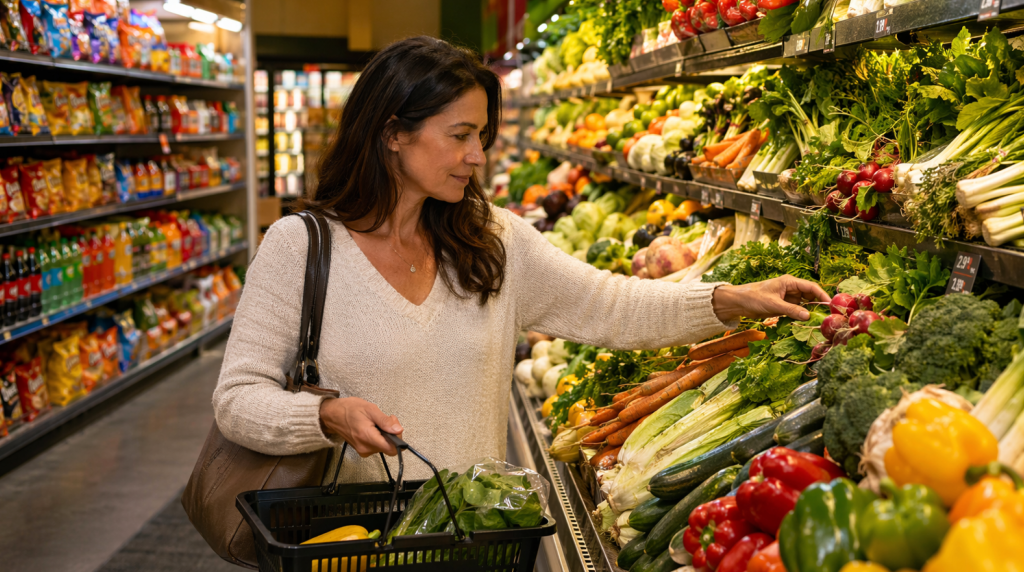
Here is where this connects to freight in a way most logistics teams have not modeled. Fresh produce and protein move on temperature-controlled equipment. Processed snacks and sugary beverages largely do not. The shift in food category winners and losers is also a shift in equipment type demand. For reefer carriers, the volume mix is gradually moving in a more favorable direction. For dry van carriers running high-calorie CPG lanes, the headwind is quiet but it is structural.
What the Freight Market Is Already Showing
This is not entirely theoretical. FreightWaves documented early market signals in March 2026: softer reefer and dry van demand in specific CPG segments, reports from brokers of lighter loads in snack-heavy lanes, and early volume softness in certain categories that does not track with broader economic conditions. The pattern is specific enough to point toward a behavioral cause rather than a macroeconomic one.
ACT Research's March 2026 reefer market analysis added a detail worth tracking separately. Discretionary refrigerated volumes remain sensitive to consumer trends, the analysis noted, while food and pharmaceutical freight remain the most consistent demand anchors. Beverage, CPG, and discretionary perishables continue to reflect uneven consumer behavior. Put another way: the reefer market is already showing exactly the divergence that GLP-1 adoption would predict. Essential food and pharma freight is holding. Discretionary refrigerated CPG is not.
The CPG companies themselves are saying it. Food Dive reported in February 2026 that shoppers have not returned at the rates companies expected after prior-year softness, prompting some to roll back prices and reprioritize product innovation. The language on earnings calls has shifted from describing temporary consumer pressure toward something closer to acknowledging that consumption patterns may have changed in a more lasting way.
The Counterbalance Nobody Mentions
The GLP-1 story in freight has a positive dimension that gets buried in the volume-loss narrative.
Manufacturing the drugs generates freight. New pharmaceutical production facilities are creating substantial truckloads of construction materials, specialized equipment, and components. The pharmaceutical cold-chain, which handles temperature-sensitive biologics and injectables, is growing in parallel with GLP-1 production ramp-up. ACT Research specifically named food and pharmaceutical freight as the most consistent reefer demand anchors in their March 2026 analysis. For reefer carriers building pharmaceutical logistics relationships, GLP-1 production is a genuine tailwind.
Food company reformulation is another offset. Major food conglomerates are not standing still as category volumes soften. They are reformulating products and introducing GLP-1-friendly formats, repositioning toward protein-forward, portion-controlled, and nutrient-dense offerings that align with where consumer spending is going. Some of that creates new freight flows: different packaging lines, different distribution patterns, different shelf placement. The composition of food freight changes even when total volume does not collapse.
A third factor makes this more durable than a typical consumer trend. Food Dive's analysis of the 2025-2030 federal Dietary Guidelines for Americans found that federal nutrition policy now explicitly recommends prioritizing protein at every meal and significantly reducing refined carbohydrates. Three forces have converged: GLP-1 medical behavior change, commercial food industry reformulation, and federal nutrition guidance. That convergence makes the category winners and losers more predictable and more persistent than they would be from any single driver.
What Shippers in Food, Beverage, and CPG Should Be Doing
Most food and CPG shippers have not run this analysis against their freight network. The connection between a weight loss drug and the routing guide for snack delivery lanes is not a standard supply chain planning scenario. The fact that it should be is the point of this article.
Category exposure is the starting point. If your freight is concentrated in processed snacks, sugary beverages, beer and alcohol, high-calorie convenience formats, or bulk carbohydrate products, you are in the lanes under the most direct GLP-1 pressure. The volume may not have shifted significantly yet. But the consumer demographic in those categories is changing, the long-term direction is down, and knowing your specific lane-level exposure now lets you model what a 5% or 10% volume decline actually means for carrier relationships, routing guide coverage, and distribution network design rather than discovering it after the freight has already moved.
The product mix question matters just as much. If your company is introducing protein-forward or fresh-adjacent formats, those products often move on different equipment, through different channels, and with different temperature requirements than the products they are replacing. A shift from center-store processed snacks to deli or refrigerated protein is also a shift from dry van to reefer, from long shelf life to faster turns, and from national DC distribution to more regional sourcing. The logistics infrastructure for the new product may not look anything like the logistics infrastructure for the old one, and that gap is a planning problem if you discover it at launch rather than in advance.
Timing is the third variable. GLP-1 penetration is at 12% and growing. Circana projects 35% household exposure by 2030. The freight effects of the first 12% are already showing up as quiet category softness. The effects of 35% will be structurally significant in specific lanes. Shippers who have mapped their exposure and built flexibility into their networks before volumes shift will have options that those reacting after the fact will not.
What Carriers Running Food Freight Should Be Watching
For reefer carriers, the category shift is a moderate near-term tailwind and a more meaningful long-term structural change.
Fresh produce, protein, dairy, and pharmaceutical freight are all growing their share of refrigerated volume relative to discretionary CPG. ACT Research's March 2026 analysis confirmed that essential food and pharmaceutical categories provide the most consistent reefer demand anchor, while beverage and discretionary perishables are the weak spots. Carriers building depth in produce, fresh protein, and pharmaceutical cold-chain are positioning toward the freight categories that GLP-1 adoption is actively supporting. The other side of that coin: carriers heavily concentrated in beer, soda, and discretionary refrigerated snacks should be watching volume trends in those lanes closely and thinking about how to diversify their freight mix before the shift becomes more pronounced.
For dry van carriers running CPG lanes, the same category analysis applies differently. Processed snack and sugary beverage lanes have been reliable and high-volume for decades. They are not disappearing. But they are structurally softer than they were, for a reason that has nothing to do with the rate cycle or the business environment.
The GLP-1 story in freight is still early. The direction is clear, the penetration rate is accelerating, and the freight market rarely rewards the people who recognized the trend after it had already moved.
Questions about how shifting consumption patterns are affecting your freight network or carrier strategy? Let's talk.
📞 (931) 200-5601 | [email protected]
Research and reporting drawn from: FreightWaves, Ozempic Slims America and It Is Lightening Truckers Loads, March 2026; Circana report on GLP-1 household exposure and food and beverage sales projections, November 2025; Food Dive, GLP-1 Users to Make Up 35% of Food and Beverage Sales by 2030 and Revisiting the Predictions: How Have GLP-1s Changed the Food Industry, November 2025 and March 2026; Food Navigator USA, The GLP-1 Effect: How 2026 Will Look for Food and Beverage and From War-Driven Inflation to GLP-1 Eating Trends, December 2025 and March 2026; ACT Research February and March 2026 Reefer Freight Rate and Market Analysis; PwC, What Is the Future of GLP-1 Trends and Its Impact on Business Models; Marriner Marketing, How Will GLP-1s Impact the Food and Beverage Industry in 2026; IndexBox, GLP-1 Drugs Reduce Food Freight Demand by 3%, Impacting Truckload Volumes; Gallup National Health and Well-Being Index, GLP-1 adoption survey data, 2025; BMJ, GLP-1 Agonists: US Sees 700% Increase in Non-Diabetic Patient Treatment.