
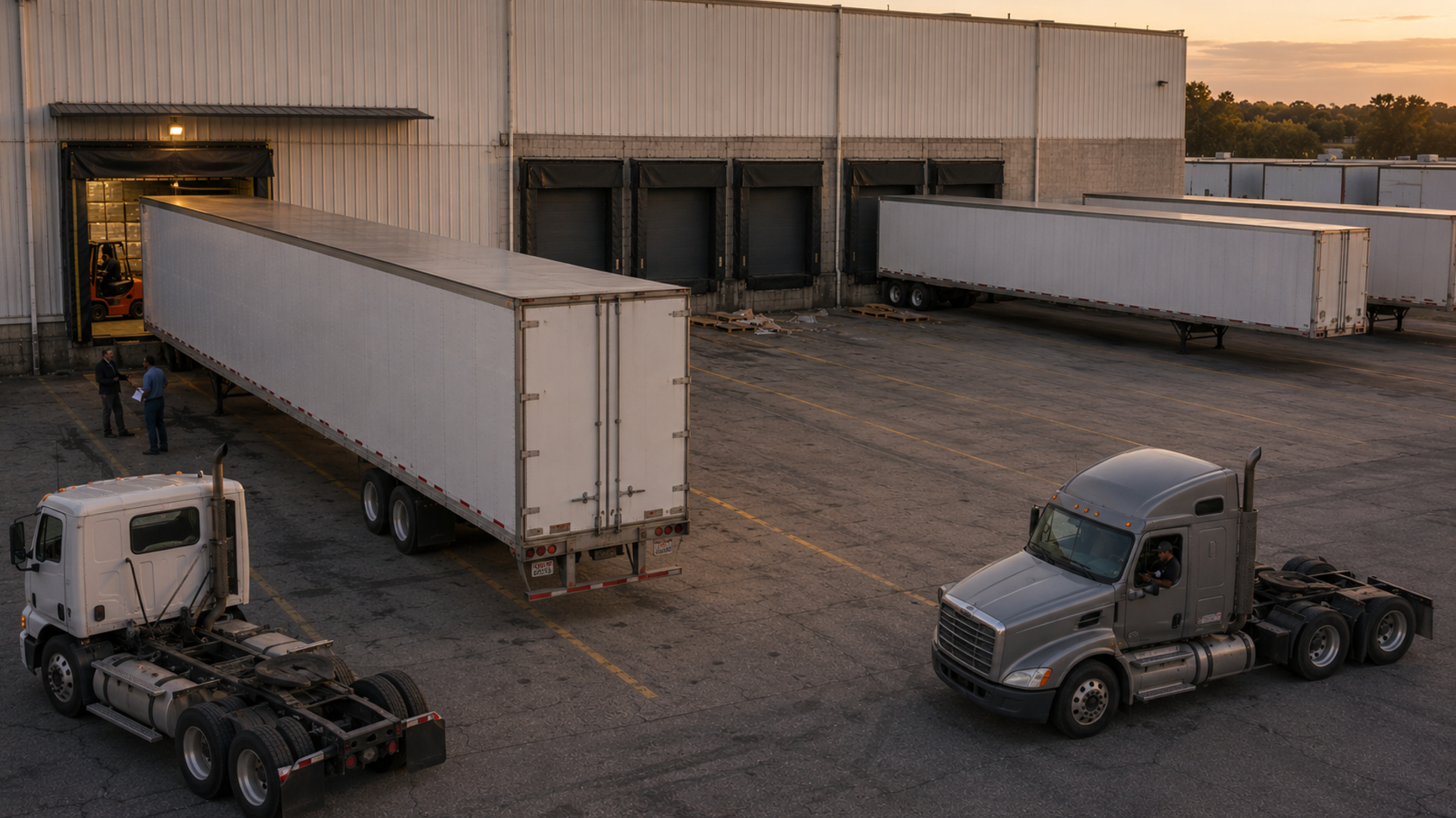
For the past five years, “shipper of choice” lived primarily in conference presentations and the marketing decks of third-party logistics firms. It was a phrase that played well in a slide and read well in a vendor pitch, sitting somewhere between brand reputation and supplier relationship management for most of the soft market from 2022 through most of 2025. That treatment made sense at the time. Carriers needed loads. They accepted detention, dwell, difficult facilities, late payments, and inefficient communication because the alternative was sitting empty with a payment due on the truck.
The underlying math is no longer what it was.
Carriers in the current freight market are not accepting any load they can get. They are choosing which shippers to accept freight from, based on facility performance, payment terms, communication quality, and the operational friction of working with that shipper relative to others competing for the same capacity. Shipper of choice is no longer a marketing concept. It is the procurement variable with the most direct impact on rate, capacity, and service reliability in 2026, and most logistics teams have not updated their operational practices to reflect that change.
This article is about what those changes actually look like at the warehouse, dock, scheduling, and payment levels, and why getting them right before H2 2026 tightens further is the most concrete strategic action a logistics leader can take this quarter.
What Carriers Are Actually Saying
Listen to a Q1 2026 earnings call and the selection criteria are no longer subtext.
On the Knight-Swift call, CEO Adam Miller pointed out that shippers limiting bid participation to asset-based carriers are seeing materially better coverage right now. Asset-based versus non-asset is not really the point Miller was making. What Miller was identifying is that carriers in this market are choosing which shippers to commit capacity to, and the shippers winning those choices share specific characteristics. Schneider National’s CFO described 2026 as a “doing more with less” environment, with dedicated capacity flowing toward shippers offering operational consistency rather than chasing spot volume. J.B. Hunt’s Q1 numbers told the same story from a different angle, with the dedicated contract book getting more emphasis precisely because shipper performance is more predictable when you control the lane.
Covenant Logistics went further on its Q1 call. The fleet is shrinking on purpose to lift utilization and margins, the dedicated specialized side is growing, and the freight Covenant is walking away from got a label: “generic TL services.” Sit with that word choice for a second. A carrier calling a category of freight “generic” while exiting it is not making a marketing distinction. The translation is lanes and shippers where the operational economics no longer pencil out, and the carriers running those lanes have moved past the pricing conversation.
DAT’s May 2026 freight intelligence release made the same case from the data side. If your procurement playbook was written in 2024, it was written for a different market, and the spot exposure showing up in your routing guide right now is the cost of that mismatch. C.H. Robinson’s May 2026 market update added the contract context: carriers are becoming more selective about which loads they accept, and shipper facility performance is part of that selection criteria in a way it was not 18 months ago.
The pattern across carrier commentary is consistent. When capacity is constrained, the loads that get covered first are the ones that cost carriers the least to run. Three years of recession taught surviving fleets to run lean. Nobody is unlearning that lesson in 2026 by signing up to absorb predictable losses at a shipper that has not changed its facility behavior.
Where the Real Money Lives: Detention and Dwell Time
Most of the friction between carriers and shippers cashes out in detention, and the numbers around it are sharper than what usually gets pulled into a procurement review.
ATRI’s research on detention and dwell time, the most comprehensive industry data set on the subject, puts the total annual cost to the trucking industry at $15.1 billion. Of that, $11.5 billion comes from lost productivity. Another $3.6 billion is direct unrecovered expense. Per-driver losses run between $11,000 and $19,000 annually. Truckload drivers spend roughly 173 hours per year sitting in detention, the equivalent of more than 15 full work days that generated no revenue.
The shipper-side numbers tell their own story. 39.3% of all driver stops experienced detention in 2023, with 4.9% running more than four hours. Carriers attempt to charge for the time through accessorial fees, but ATRI’s research found a gap between contract language and actual collection: 94.5% of fleets have detention fees in their contracts, while fewer than half actually collect on them. Hourly detention charges typically range from $25 to $100, with $63 being the industry average against an average carrier operating cost of $66.65 per hour. Even when collected, detention payments do not fully compensate for the operating cost of a sitting truck.
The safety side of detention rarely makes it into a procurement review, and it should. Speed goes up 14.6% in the hours after a detention event, per ATRI’s data. Crash risk climbs another 6.2% for every 15-minute bump in dwell time, FMCSA found. Detention is not just an economic problem. It is a safety problem that creates liability exposure for the carrier and, increasingly, for the shipper.
Carriers absorbed most of these costs during the soft market because the alternative was no freight at all. In 2026, the alternative is freight from a different shipper whose facility runs efficiently. Friction that used to be tolerated is now a filter, and most shippers have not caught up to what that change means for their routing guide.
What Carriers Are Actually Filtering On
Carrier evaluation criteria for shipper relationships have gotten specific. Six categories repeat across earnings calls, ATRI’s research, and the freight market analysts watching the procurement side.
Facility throughput performance. Average dock-to-dock time is the first number a carrier looks at, then appointment compliance within the scheduled window, then how often detention crosses two hours, then whether drop-and-hook is being used where the freight actually warrants it. Carriers track all of it by shipper across thousands of loads, which means somebody on the carrier side already knows which of your facilities loses them money.
Appointment scheduling discipline. Honoring the time you scheduled is the baseline. What separates good shippers from bad ones is how the unavoidable delays get communicated, and whether your routing guide builds in the kind of transit math that any dispatcher can look at and know is impossible. A facility that runs late as a matter of course compounds HOS pressure across every driver who touches it, and that pressure lands on the carrier’s books, not yours.
Payment terms and reliability. Net 30, net 45, and net 60 are different procurement realities for carriers operating on thin working capital. A carrier can factor to close the timing gap, but factoring is not free, and the cost lands on the same P&L that is already absorbing your detention. Drag out an invoice dispute for three weeks and you are not creating a paperwork problem for the carrier. Payroll, fuel, and maintenance obligations run on their own schedule, and that schedule does not wait.
Communication infrastructure. Accurate load information at the time of tender is the entry point: reference numbers, BOL details, special instructions, all of it correct before the driver leaves the previous stop rather than corrected from your dock at 4 a.m. The other side of this is whether your dock contacts pick up when a driver has a problem at the gate, and whether load changes get pushed to the carrier in time to matter rather than after the truck is already in your yard.
Cargo readiness. Whether freight is staged and ready at the appointment time, or whether the driver is waiting while the facility builds the load. Documentation prepared in advance, not pulled together while the driver sits at the desk. Enough equipment and bodies on the receiving side to actually unload the truck inside the window.
Facility working conditions. Driver bathroom access. Whether early arrivals can find a place to park. A reasonable rest opportunity during a long unload window. Anyone calling these soft amenities has not talked to a driver lately. Loads to specific destinations get accepted or refused on this stuff, and the carriers running those lanes feel it in their retention numbers a quarter later.
Why This Compounds Across the Network
A single bad facility you can usually work around. What you cannot work around is the moment your facility behavior puts you in the bottom quartile across two or three carriers at once, and most shippers have no clean way to see themselves from the other side of that desk.
The visibility gap is closing fast on the carrier side. Telematics and detention-pattern tools have given fleets enough resolution to track facility behavior shipper by shipper, FleetOwner reported recently, and routing and pricing decisions are already being adjusted on the back of that data. Brokers see the same picture because carriers tell them in real time which loads to refuse and which ones earn a premium. Damage from poor facility behavior does not stay with one carrier anymore. The reputation travels, and it travels with every load that leaves your dock.
The opposite is also true. Efficient facilities, detention paid when it is owed, clear communication, drivers treated respectfully. Carrier preference accumulates from those things the same way resistance accumulates from the bad version. Carriers tell each other where the good loads are. When capacity tightens and a carrier has to choose between two pickups on the same morning, the shipper with the better facility reputation gets the truck.
None of this is theoretical. Dispatch decisions are being made on this calculation every morning at fleets across the country, and the routing guide failures shippers are running into this month are one of the visible downstream effects.
What Logistics Leaders Can Do Right Now
There is a window right now for shippers to move up in carrier selection. It will not stay open through H2. Three operational levers do the actual work, and none of them require approval from anyone outside the logistics function.
On facility performance, start with a detention audit by location and lane. Pull data on average load times, detention frequency, and appointment compliance for every facility in the network. The worst performers usually have operational causes underneath them that an audit will surface quickly: dock capacity, staffing misalignment with appointment windows, freight staging, documentation readiness. Fixing a chronically underperforming facility is not cheap, but the return shows up in carrier acceptance rates and lower spot exposure, typically inside one to two quarters under current market conditions.
On payment and contracts, accelerating payment terms from net 45 or net 60 down to net 14 or net 21 has real cash flow value for carriers and almost no cost to shippers operating on standard working capital. The pattern that builds carrier preference is paying detention when it is properly invoiced, rather than disputing every accessorial charge by default. That single behavior signals more about how a shipper operates than any marketing language ever will. Reviewing accessorial dispute rates and addressing the systemic causes is operational maintenance with direct procurement value.
On communication and information quality, the actions are tactical but they compound. Complete and accurate load information at tender. Real-time delay notification when appointments will slip. Dock contacts who answer their phones. Driver-friendly facility policies that include reasonable parking, bathroom access, and break opportunities. None of these are expensive to implement. All of them are visible to carriers and accumulate into reputation over hundreds of loads.
The shippers winning capacity in May 2026 are not the ones with the largest freight networks or the deepest procurement teams. They are the ones whose facilities and processes have been engineered to minimize operating friction for the carriers serving them. That is an operational discipline, not a procurement strategy in the traditional sense, and the logistics leaders building it now are positioning their organizations for a market that will reward operational excellence more directly than any soft market in recent memory has.
Shipper of choice is no longer something to put in a marketing deck. It is the variable that determines whether your routing guide holds in H2 2026, and the carriers making that determination are watching how you run your facilities every day.
Questions about how facility performance, payment practices, and operational discipline are affecting your carrier relationships? Let’s talk.
📞 (931) 200-5601 | nfc@nationalfreightconnection.com
Research and reporting drawn from: Knight-Swift Transportation Q1 2026 earnings call and Adam Miller commentary; Schneider National Q1 2026 earnings; J.B. Hunt Q1 2026 earnings; Covenant Logistics Q1 2026 earnings call; C.H. Robinson May 2026 North America Truckload Freight Market Update; ATRI Costs and Consequences of Truck Driver Detention research and 2026 Operational Costs of Trucking benchmarking; FleetOwner, How Detention Time Is Reducing Trucking Efficiency and Increasing Carrier Costs; FreightWaves May 2026 State of the Industry; DAT Freight Analytics May 2026 shipper intelligence release; FMCSA detention and dwell time research; OOIDA driver detention survey data; Capstone Logistics dwell time analysis.